





It was meant to be a good week for Anand Teltumbde.
The academician-activist had been invited to speak at a book discussion at the immensely popular Kala Ghoda Arts Festival in Mumbai. And a court gave him permission to leave Mumbai for the first time since October 2022, when he had been granted bail after spending 31 months in jail on the condition that he stayed within the city.
The professor at the Goa Institute of Management had been arrested in April 2020, accused along with 15 others of being part of a dubious conspiracy to spark caste riots in the village of Bhima-Koregaon near Pune in 2018.
Finally, after more than two years of being confined to Mumbai, Teltumbde had been allowed to travel to a family wedding.
Since the wedding trip clashed with the book discussion, Teltumbde asked the organisers of the Kala Ghoda Arts Festival to reschedule the event.
I was party to this information only because I had been invited to moderate the discussion, titled “Incarcerated: Tales from Behind Bars”. Teltumbde was to speak about his book The Cell and the Soul: A Prison Memoir. Also on the panel was Neeta Kolhatkar, author of The Feared: Conversations with Eleven Political Prisoners.
Since his release, Teltumbde has been breathtakingly prolific: since October 2024, he has published six books. But he has been unable to speak about them at events in other parts of the country. In November, a court rejected his petition to be allowed to participate in a books event in Kochi because it was an “academic luxury”.
Thanks to the welcome court order, the Kala Ghoda event was advanced to Thursday. But on Tuesday night, we learnt to our dismay that the Mumbai Police had asked the organisers to cancel our discussion. No reasons were given.
The police order came hours after Hindutva “influencers” took to social media to criticise the decision to offer Teltumbde a platform to speak about his horrific experiences in jail. Though no official complaint seems to have been made, the authorities acted with alarming alacrity. Teltumbde’s bail conditions do not preclude him from speaking in public so there would not seem to be any legal basis for the prohibition.
Teltumbde has not been convicted of any crimes. In fact, the trial in the Bhima-Koregaon case is yet to begin. Yet, it is evident from the attitude of the authorities that Teltumbde is being denied a foundational principle of justice – the presumption of innocence.
Preparing for the Kala Ghoda event, I not only read the books by Teltumbde and Kolhatkar but also several of the other recent additions to the growing library of memoirs by political prisoners about the subhuman conditions in India’s jails and routine humiliations that are meted out to inmates – overcrowded barracks, inedible food, filthy toilets, inadequate water supplies, being penalised for demanding the rights laid out in black and white in prison manuals.
In From Phansi Yard, Sudha Bharadwaj – also accused in the Bhima-Koregaon case – observes that India’s carceral facilities do not aim to reform or rehabilitate but to punish and extract revenge. The penal system, Kobad Ghandy writes in Fractured Freedom, “is constructed to break the individual: mind, body and soul”.
The account of prison life that I am most familiar with is Colours of the Cage by my friend, the activist Arun Ferreira. He wrote it in 2014 after he was acquitted in 10 of 11 cases in which he had been arrested in 2007. In his conclusion, Ferreira described his fear that when he resumed his support for civil rights movements, he would be re-arrested.
That is exactly what happened four years later, when he too was accused in the Bhima-Koregaon case.
When he asked me to write the foreword to his book, I didn’t realise that it would also apply to the stifling of the Kala Ghoda discussion this week. Ferreira’s jail memoir – and those by other political prisoners – remind us “that diversity of opinion and debate are essential for any society to flourish”, I had written. “The worst thing we can do to ourselves is to imprison our imaginations.”
Here is a summary of last week’s top stories.
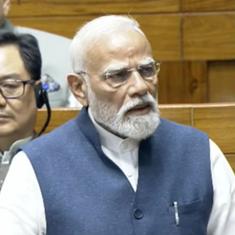
Book sparks row. The Lok Sabha on Thursday passed the Motion of Thanks on the president’s address without Prime Minister Narendra Modi giving his customary reply as the Opposition continued its protest. This was the first time since 2004 that the prime minister has not replied to the motion in the Lok Sabha.
The Opposition was protesting against Congress leader Rahul Gandhi not being allowed to quote an excerpt of an unpublished memoir of former Indian Army chief MM Naravane about the political decision-making during the 2020 border tensions between India and China.
In 2004, the Bharatiya Janata Party, in Opposition at the time, had prevented Manmohan Singh from responding to the motion.
Modi was expected to speak in the Lower House at 5 pm on Wednesday. However, amid protests by Opposition MPs, the proceedings in the Lower House were adjourned till Thursday. But the prime minister’s speech did not take place.
A new Manipur government. Bharatiya Janata Party leader Yumnam Khemchand Singh took oath as the chief minister of Manipur on Wednesday, forming a new government and ending a year of President’s Rule in the state. The Hindutva party’s Nemcha Kipgen, who belongs to the Kuki community, and ally Naga People’s Front MLA Losii Dikho, from the Naga community, were sworn in as the deputy chief ministers.
Kipgen took oath virtually from New Delhi after Kuki groups objected to her joining the government led by Khemchand Singh, a Meitei leader. Kuki groups have called on MLAs from the community not to take part in the new government.
The President’s Rule was imposed in February 2025 after N Biren Singh stepped down as the chief minister amid allegations from Kuki-Zomi-Hmar groups that his response to the ethnic violence in Manipur had been partisan and that he had stoked majoritarianism.
Kuki-Zo groups have maintained that the creation of a separate administrative arrangement in the form of a Union Territory, in the areas of the state dominated by the community, is the way forward to end the conflict.
The India-US trade deal. The Union government told Parliament that sensitive sectors such as agriculture and dairy will be protected under the trade deal between India and the United States. Washington, while cutting tariffs on India to 18%, has also protected sectors that it considers sensitive, Union minister Piyush Goyal said.
This came even as the joint statement on the deal on Saturday said that New Delhi will eliminate or cut tariffs on several US agricultural and food products, including dried distillers’ grains, red sorghum for animal feed, tree nuts, fresh and processed fruit, and soybean oil.
The Opposition has claimed that Modi “sold out” the “sweat and blood” of the country’s farmers by buckling under pressure from Washington to finalise a deal.
India also plans to purchase $500 billion worth of US energy products, aircraft and aircraft parts, precious metals, technology, and coking coal in the next five years, the joint statement said.
India will gain improved access to the US market to sell textiles, footwear, plastic and rubber products, organic chemicals, and select machinery. The US will also entirely remove tariffs on generic pharmaceuticals and gems. Washington also removed the 25% punitive levies for India’s purchase of Russian oil.
Also on Scroll last week
- Interview: ‘If Bangladeshis want hijab law, we will support,’ says Jamaat-e-Islami media head
- ‘International conspiracy’: Why the BJP is opposing the Roman script for Tripura’s Kokborok tongue
- Why acid attack survivors face a long wait for justice
- Judge, activist blew whistle on deaths in Meghalaya mines – days before third explosion killed 25
- Watch: ‘I am in pain everyday’: How debt pushed a town in Tamil Nadu into selling kidneys
- Why protestors are walking 700 km across Rajasthan to protect sacred groves from solar projects
- Anand Teltumbde: Stay on UGC rules was disproportionate – six counterpoints to the objections
- What Ceylon looked like through the eyes of KPS Menon
- Tamil film ‘Mayilaa’ is a tribute to ‘women whose lives and pain often remain unseen and unheard’
- How Tannishtha Chatterjee did a play and a film during cancer treatment: ‘Art, humour and community’
Follow the Scroll channel on WhatsApp for a curated selection of the news that matters throughout the day, and a round-up of major developments in India and around the world every evening. What you won’t get: spam.
And, if you haven’t already, sign up for our Daily Brief newsletter.
